Building a $533M Partnership: From Marginal Alliance to Strategic Priority
Problem
When I joined, Globant's Microsoft partnership was worth about $41M a year in contract value. To Microsoft, that barely registered. There was no real process for how our sales teams worked with theirs, no shared playbook, nothing that would hold up if I stepped away. The relationship wasn't struggling because the opportunity was small. It was struggling because nothing had been built to make it work at scale.
Constraint
I had no direct reports and no formal power to make regions fall in line. What I did have was some say over budget and a direct line to our Managing Directors, plus regular time in front of the Regional CBO and CRO. Everything I wanted to change had to happen through influence and design, not through telling people what to do.
We weren't winning the Microsoft relationship because we didn't have the right capabilities. Microsoft literally couldn't see what we were doing. Nothing else mattered until that was fixed.
Approach
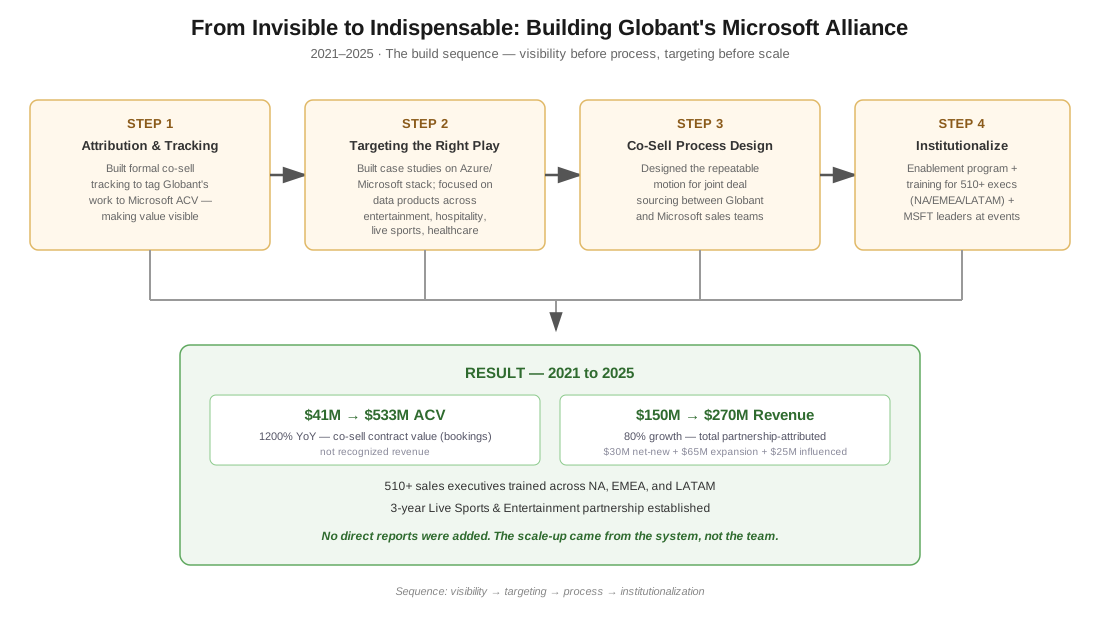
The work started with a formal way to track and tag Globant's involvement to actual Microsoft contract value, making the relationship's worth visible and countable for the first time.
From there, I built out a set of real case studies grounded in specific Microsoft technologies, Azure and the rest of their stack, and used them to figure out where we were genuinely strong. That led us to data products across entertainment, hospitality, financial services, live sports, and healthcare. Figuring that out before process design helped us decide which industries were actually worth building a repeatable motion around.
Once I had that visibility and that focus, I designed the co-sell process, then the enablement program, then a regional training curriculum that reached over 510 executives across three regions. I also started inviting Microsoft's own product and sales leaders to our company events, building direct relationships between both teams.
Outcome
Co-sell contract value scaled from $41M to $533M, a 1200% increase. Separately, our total partnership revenue, across this alliance and others, grew from $150M to $270M, 80%, which also included 110% growth in AI services revenue specifically. Over 510 executives across North America, EMEA, and LATAM went through the training. Alongside all this, we also landed a 3 year Live Sports and Entertainment partnership.